Courses / Self-loading rifle / Lesson 4
Carry, transport and store
What the law and good sense require. Lesson 4 of 8 · about 6 minutes to watch.
Watch
Step through the slides. The trainer's words are under each one.
Carry, transport and store
Self-loading rifle, lesson 4 of 8: what the law and good sense require
The unit standard asks you to control, carry and transport your rifle without risk to anyone, in line with the law, and it says control includes safe storage. Most of the rules come from the Firearms Control Act and its Regulations, and they're simple once you see them together.
In public: covered, in a proper holder, under control
- In a case or holder made for the rifle
- Completely covered
- Under your effective control at all times
- Never carried openly in a public place
Section 84 of the Act sets the rule for carrying in a public place. A rifle must be in a holder designed, made or adapted for carrying it, such as a rifle case or slip. It must be completely covered, and you must be able to exercise effective control over it. In practice, the rifle goes from your safe to your car to the range in its case, and nobody in the street sees it. Breaking this rule carries up to two years.
Transporting your rifle
- 1Unload itMagazine out, chamber checked
- 2Case itIn a case made for it
- 3Keep it coveredOut of sight in the vehicle
- 4Never leave it unattendedUnless in a lock-away safe bolted to the vehicle
Section 83 says firearms must be stored and transported in the prescribed manner. For a private owner that means: unload the rifle, put it in its case, keep it covered and out of sight, and keep it under your control. A rifle on the back seat while you pop into a shop is a rifle a thief can take. If you truly must leave it in the vehicle, it goes in a lock-away safe fixed to the vehicle body, as regulation 86 describes.
What a lock-away safe must be
Regulation 86(12) describes a lock-away safe: steel at least 2 millimetres thick, enclosing the whole firearm, with an integral lock, and able to be fixed to a wall, a floor or a vehicle body. Check that a lock-away safe actually fits your rifle before you rely on one, and better still, plan the trip so the rifle never has to be left in the car.
At home: the rifle and its ammunition, locked away
- 1Not on you?Not under your direct personal control
- 2Into the safeSABS 953-1 safe or 953-2 strongroom
- 3Ammunition tooLocked away with it
- 4UnloadedOnly a section 13 firearm may be stored loaded
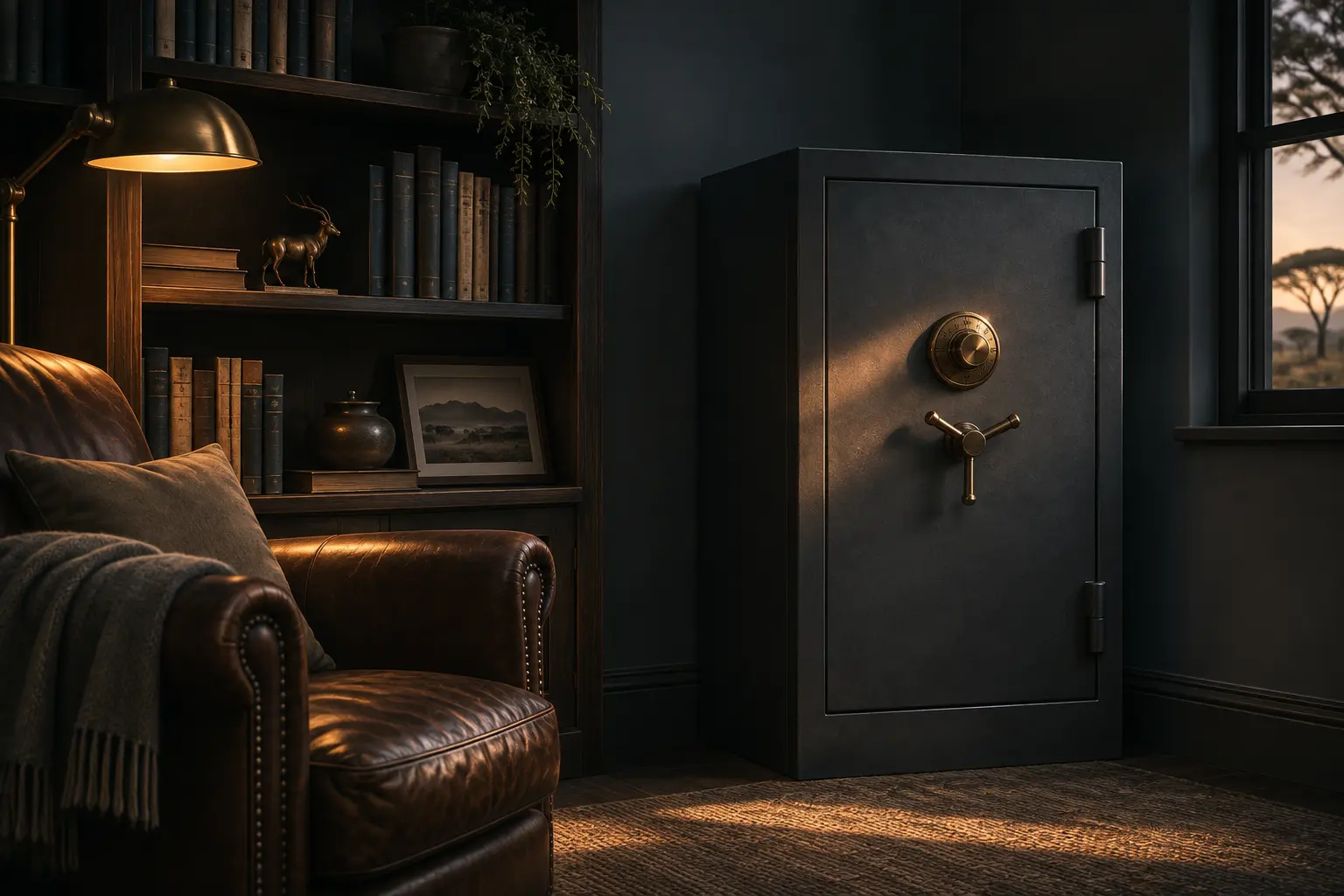
Regulation 86 is the rule at home. Whenever the rifle isn't under your direct personal and physical control, the rifle and its ammunition must be locked in a safe or strongroom that meets SABS 953. Only you should be able to open it, or it shouldn't open without you there. And a self-loading rifle is stored unloaded: only a section 13 self-defence firearm may be stored loaded, and a self-loading rifle is never a section 13 firearm. Failing to lock it away is an offence carrying up to five years.
Lawful or not?
| Situation | Lawful? | Why |
|---|---|---|
| Rifle cased and covered in the boot on the way to the range | Yes | Covered, unloaded, under control |
| Rifle on the back seat while you shop | No | Unattended and not locked away |
| Rifle in the safe, ammunition in a kitchen drawer | No | Ammunition must be locked away too |
| Rifle carried uncased through a shopping centre | No | Must be completely covered in public |
| Rifle stored unloaded in a bolted SABS 953 safe | Yes | Exactly what regulation 86 requires |
Here are five everyday situations. Cased and covered on the way to the range: lawful. On the back seat while you shop: not lawful, and an easy theft. In the safe but with the ammunition in a drawer: not lawful, because the ammunition must be locked away too. Uncased through a shopping centre: not lawful. Unloaded in a bolted, compliant safe: exactly right.
Storing someone else's rifle
- Only with the owner's written permission
- Endorsed by the DFO
- You may not use it
- Only the owner may take it out and transport it
Sometimes a friend asks you to keep a rifle in your safe. You may, under regulation 86(4), but only with the owner's written permission, endorsed by the Designated Firearms Officer. You may not use the rifle, and only the owner may remove it and transport it. Without that paperwork, you'd be in possession of a firearm you're not licensed for.
Thandi plans a match weekend
- Rifle unloaded and cased in the boot, covered
- Ammunition in a separate locked box
- She drives straight to the range; no stops with the rifle in the car
Thandi has a club match two hours away. She plans it so the rifle is never left alone: unloaded and cased in the boot, covered, ammunition locked in a separate box, and no stops on the way with the rifle in the car. Anel's advice: plan the trip before you pack the rifle, not after.
Your turn
Before lesson 5
- Do the exercise: Lawful or not?
- Answer four quick questions on this lesson
- Apply: check where your safe will go and how it will be bolted down
Sort the situations into lawful and not lawful, then answer four questions. Then look at your home: where will the safe go, and what will it be bolted to? Next lesson: the law on when you may use a firearm at all.
Do: Lawful or not?
Thandi and her clubmates on the way to, at and after a match. Is each one lawful?
Check
Four quick questions. The reason shows as soon as you answer.
Apply
Where this shows up in your own life.
Check where your safe will go at home and what it will be bolted to.
Ridgeview Firearms Academy and its people are fictional. This is study material written from the Firearms Control Act and the SAQA unit standards. It isn't an accredited course or legal advice; your accredited training provider runs the official tests.