Watch
Step through the slides. The trainer's words are under each one.
Shooting fundamentals
Shotgun, lesson 6 of 8: stance, grip, aim, trigger and follow-through
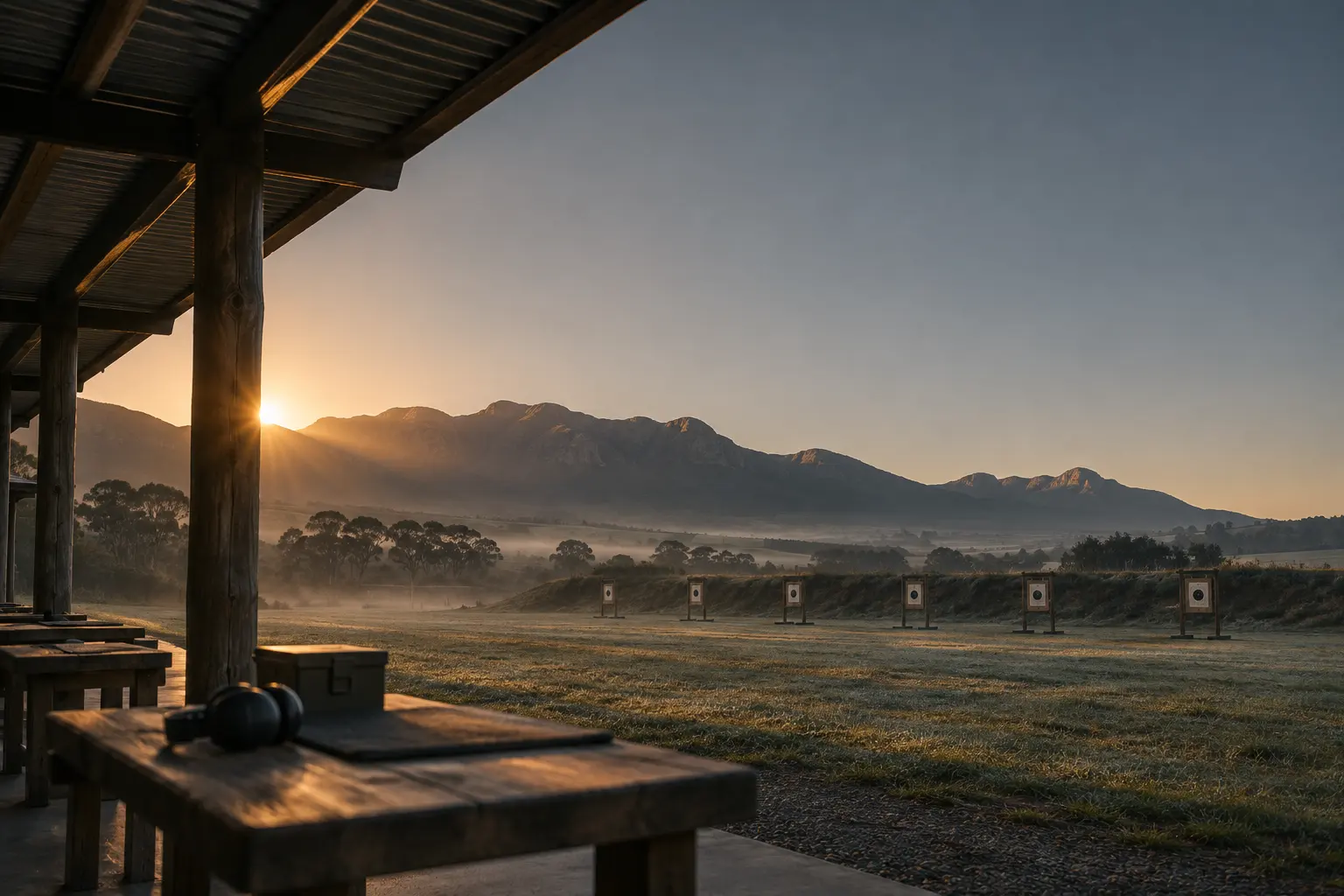
This is lesson 6: shooting fundamentals. Stance, grip, aim, trigger and follow-through. We carry on with Johan and his instructor, Anel, at Ridgeview.
Five fundamentals
- 1StanceBalanced, weight slightly forward
- 2Grip and mountStock in the shoulder pocket, cheek on the stock
- 3AimEye along the rib, bead on the target
- 4Trigger controlA smooth press, not a snatch
- 5Follow-throughStay on the line after the shot
Every good shot is the same five things. A balanced stance. A firm grip and a consistent mount. Aiming, with your eye looking along the rib and the bead on the target. A smooth trigger press. And follow-through: staying with the shot after it has gone. The unit standard calls these the fundamentals, and asks you to show them.
Stance
- Feet about shoulder-width apart
- Weight slightly on the front foot
- Front knee slightly bent
- Lean into the gun to manage recoil
Stand with your feet about shoulder-width apart, your weight slightly on your front foot and your front knee slightly bent. Lean a little into the gun. A shotgun recoils firmly, and a stance that leans back lets it push you off balance and spoils the next shot.
Grip and mount
The mount is what makes a shotgun shoot where you look. Bring the stock firmly into the pocket of your shoulder, just inside the shoulder joint, not on the arm. Bring your cheek down onto the stock, in the same place every time, so your eye sits behind the rib. Your front hand holds the forend firmly to steer the gun; your rear hand holds the grip, with your finger off the trigger. A loose mount hurts and misses.
Aim: point, don't squint
- Both eyes open if you can
- Eye looking along the rib to the bead
- Focus on the target, not the bead
- For a still target, the bead sits on it
A shotgun is pointed more than aimed. With both eyes open if you can, your eye looks along the rib to the bead. Your focus is on the target. For a moving clay you swing with it. For a still target, like the one in the practical test, you simply place the bead on it and keep your cheek down. Lifting your head to see the shot is the most common reason for a miss.
Trigger control and follow-through
- Trigger control
- A smooth, steady press
- No snatching or flinching
- Follow-through
- Keep your cheek down
- Stay on the line after the shot
Press the trigger smoothly, without snatching it or flinching in expectation of the noise. Then follow through: keep your cheek on the stock and stay on the line for a moment after the shot. Follow-through is what makes the shot go where you intended, rather than where your head went.
The right cartridge, and what's beyond
- Gauge and chamber length match the barrel
- Shot for clays and birds; slug only where it's safe and allowed
- Know where the shot will come to rest
Two checks before you fire, both from the unit standard. The cartridge must match your shotgun's gauge and chamber length. Use shot for clays and birds; a slug carries far further and needs a proper backstop. And you know where the shot will come to rest. On the range that is the safety zone; in the field, it is open ground you can see.
Shot spreads with distance
- 1At the muzzleA tight column of pellets
- 2At the targetA wider pattern, set by the choke
- 3BeyondWider still, slower, but able to injure
As the shot leaves the muzzle it is a tight column. By the time it reaches the target it has spread into a pattern, and the choke decides how tight that pattern is. Beyond the target it keeps spreading and slowing, but small shot can still injure someone a long way off. That is why the safety zone on a clay range is so large.
Johan's head comes up
Johan misses two clays in a row. Anel watches and sees his cheek lift off the stock just as he fires.
Even experienced shooters drift. On the range Johan misses two easy clays. Anel watches, and sees his head lift off the stock to look for the break just as he fires. She tells him: cheek down, follow through. The next three clays break. It is usually a fundamental, not the gun.
Your turn
Before lesson 7
- Do the exercise: Which fundamental?
- Answer four quick questions on this lesson
- Write down the gauge and chamber length stamped on your shotgun
Before you move on, do the exercise, Which fundamental?, and answer four quick questions on this lesson. Then, in your own time: write down the gauge and chamber length stamped on your shotgun. Next: what to do when it doesn't fire, feed or extract.
Do: Which fundamental?
Anel gives Johan coaching points. Say which fundamental each one is about.
Check
Four quick questions. The reason shows as soon as you answer.
Apply
Where this shows up in your own life.
Write down the gauge and chamber length stamped on your shotgun
Ridgeview Firearms Academy and its people are fictional. This is study material written from the Firearms Control Act and the SAQA unit standards. It isn't an accredited course or legal advice; your accredited training provider runs the official tests.